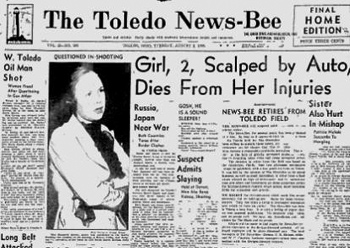

With very little fanfare save a front-page announcement, a thin fourteen-page edition marked the end of the The Toledo News-Bee on August 2, 1938. The News-Bee was the last remaining competition to The Blade (unless you count the Daybreak Dispatch in the 1970s). The announcement, reprinted in the Scripps-Howard Pittsburgh Press, read as follows:
NEWS-BEE RETIRES FROM TOLEDO FIELD
THE NEWS-BEE will suspend publication with its last edition today.
The News-Bee, for several years, has been published at a loss. So long as it appeared that there was a place in the Toledo field for The News Bee, its owners have been willing to sustain these losses, and make further investments on the chance that The News-Bee would, in time, become a reasonably profitable institution. This was done in the face of greatly increased production costs due to mounting labor costs and rising newsprint prices.
The decision to retire from the field was based on the conviction, finally, that two afternoon newspapers cannot be published, with a fair profit for both, in Toledo. It was felt by the owners of The News-Bee to be sound business, as well as good journalism, to retire from a field which offered no hope of betterment – and to concentrate time and effort and investment on those properties within the Scripps-Howard concern which occupy more favorable fields for expansion and growth.
WE REGRET the circumstances which made this action necessary, but we hold no one to blame for those circumstances. They rise from a trend in newspaper economics over which we have no control. The News-Bee has been in Toledo a long time. It is with a feeling of regret that we now suspend publication. We sincerely wish Toledo and its people well. We have only friendliness and good wishes for The Blade and its people.
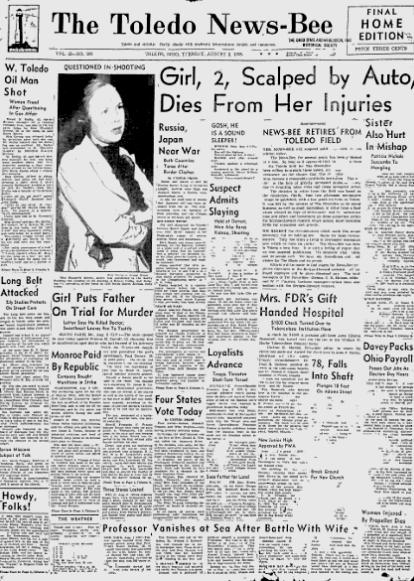
Nowhere else in that day’s News-Bee is there any hint of its folding. And nowhere in the News-Bee is notice of the business transaction that took place: The Blade had bought the assets of the News-Bee
Probably the most famous News-Bee alumni was Allen Saunders, who for many years wrote the comic strips Mary Worth, Steve Roper and Mike Nomad, and Kerry Drake.
Its editor in 1938, Carlton K. Matson, went to work for Libbey-Owens Ford before returning to the Scripps chain as a columnist and editorial writer for the Cleveland Press. His death from cancer in 1948 was notable for the uncommon way he wrote openly and frankly about his disease, in the pages of The Press and other publications where it was widely reprinted (“What I want to do is strike a blow against this mysterious, paralyzing hush-hush that surrounds every case of cancer”). Here’s the article as it appeared in the Tuscaloosa News.
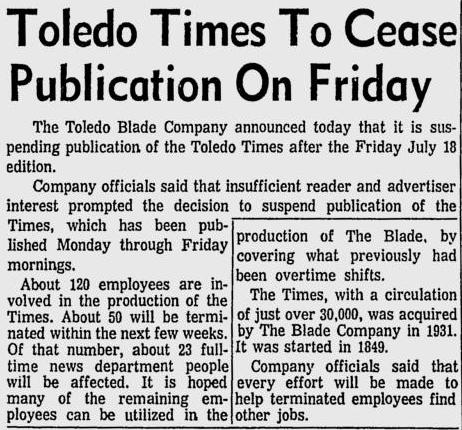
When The Blade folded the morning Toledo Times (and the last relic of the competitive newspaper history in Toledo) in 1975, it died in the same unheralded sort of way: there was a small story on the front page and nothing else was said about it. No long history about The Times, or any recounting of the history behind it.

The Blade published a great book in 1985, The Blade of Toledo: The First 150 Years, by John M. Harrison, which was mostly about The Blade (no surprise) but also went into some detail regarding the 20th century roll of Toledo newspapers:
In 1903, the Scripps-McRae League, the forerunner of Scripps-Howard and today’s E.W. Scripps Co., bought three Toledo dailies: the News, the Bee, and the Times. The News and the Bee were combined into one evening paper, while the Times continued in the mornings. During the first decade of the 20th century, the News-Bee held a fairly substantial advantage over The Blade: 86,000 subscribers versus The Blade’s 40,000 (and also, The News-Bee had a Sunday edition while The Blade did not).
Both papers ceaselessly tried to outhustle each other: being first on the street with a big story, for news, for employees. In 1931, The Blade purchased The Times, though the book is unclear as to who owned it at the time, and continued to publish it as a separate entity with a separate editorial policy.
I had always been under the impression that The News-Bee simply folded on its own, but the book notes on p. 261 that, in fact, The Blade purchased The News-Bee for $787,000 – payable in quarterly installments beginning in 1939, and continuing for 20 years. The author said in a footnote: “As late as 1950, some Toledoans still recalled the ‘good old days’ of the News-Bee, though most Scripps-Howard newspapers had by then moved well to the right politically. Even in the summer of 1984, a carry-out clerk at a Toledo grocery store suggested that a history of the News-Bee would be even more interesting than one of The Blade.” (and, you know what? This could have been me making that suggestion. For one thing, I was working at a carry-out in the summer of 1984, and for another, I had been fascinated by the News-Bee; the public library once sold off its bound volumes of Toledo newspapers and I owned a couple months of the News-Bee from the 1920s. Plus, it sounds like something I’d say to a complete stranger.)
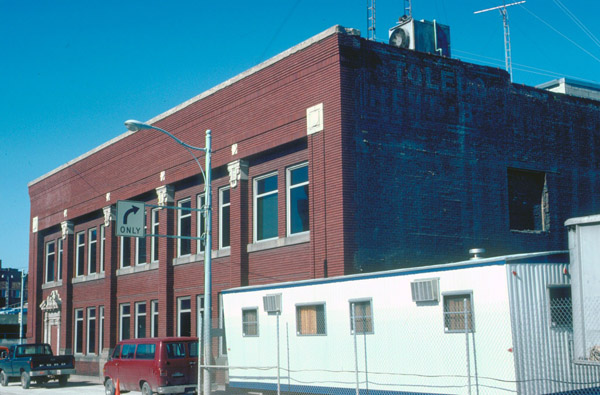
Anyway, while the history of The Blade is well-documented, the history of the News-Bee is probably gone forever. For forty-plus years after its closing, the dark red News-Bee Building, as it was called until it was torn down, was at 604 Jackson St. (at Huron) downtown, and was the home of WTOL and WIOT-FM. It opened in 1912, and the paper invited readers to come on down anytime. It was eventually demolished in the early 80s (after haggling over price) to make way for One Government Center and the boulevarding of Jackson Street.
The microfilm pages of the Toledo News-Bee are now in Google’s archive search, so you’ll no doubt be reading more about the growth pains of early 20th century Toledo here. The city grew at an overwhelming rate in The News-Bee’s heyday, from 131,822 in 1900 to 243,164 in 1920, and flipping through the papers is like looking at a mirror full of problems of a city that grew rapidly: crime, the rise of the automobile, city politics, as well as a generous amount of national and international news, all presented in a way to sell newspapers (and therefore very entertaining).
While I wrote her back separately, I did discover that Walter R. Allman was a cartoonist of some repute. He did cartoons for the News-Bee, one in particular called “Doings of the Duffs” as stated above. Incredibly (because even I was surprised I found it), I came across his obituary on July 8, 1924, and we are always glad to help a reader.
Thanks so much for you fast response. I really appreciate it! I as well as my family are very excited to find out more about the history of this wonderful cartoonist we are related to.
Thanks again
Barbie
Do you know if the News-Bee’s photograph archive wound up at a Toledo library, college or other repository? I’m interested in obtaining a copy of a photo that ran in June 1931. Thank you.
i just found some old newspapers in my brother attic from 1937 newspaper toledo news bee i handed them over to the holgate library today
1930 8 people drown or were killed on lake erie on my grandpas boat,a dart.i know he was a bootlegger,who lived off of bayshore dr.i know he was headed to pelee island and there were lawyers and irs collector on board which is ironic to be on rumrunners boat.i don’t believe this was an accident. I know the lake can get rough but not enough to throw 8 men out. lake erie mystery?
Where can I get a copy of the story in the 1937 NewsBee entitled “The Curse of Bairdstown..truth of trifle?”
I would like a copy of the article from the November 8, 1926 Toledo News Bee concerning my grandmother Adeline Huebner Englehardt, later McAlary who was awarded a $50 gold piece and a ctf fro the Editor because she raised 20 children .
I just re-read classic book HALF-MAGIC by Edward Eager, set in early 1920’s, inspired by author’s childhood
Widowed mother of main characters is “the pride of the Toledo-News Bee” for which she “worked very hard” tho it was “the one (newspaper) almost nobody on the block took”.
Recently occurred to me to look up on Google maps the many street names given in book (I’ve never been in Toledo, Ohio myself) & discovered those are real places. I don’t know if Robinson Elementary School existed then, but might be why boy named Mark while skating in neighborhood remembers he hadn’t re-read Robinson Crusoe again that year.
Another main character owns a small bookstore. Anyone recall similar store during era of silent movies ( another incident in story), or a Meinhert’s Pastry shop (where boxed picnic lunch is bought)? Children also go to the five and ten cents store and “best soda fountain in town”, but at that time, most towns would have at least one of those!
We have several chronicalized large books of the Toledo News Bee papers, I believe they are the full size issues, day by day, from the 1920’s, any idea what we could do with these books??
I’m interested in finding an article published in 1892, any ideas where to start?
The Toledo Public Library’s main branch has microfilm copies of the Toledo News-Bee.