
When Google put The Blade’s microfilm on line, the second event I went looking for was something I could only vaguely remember: a huge storm on the Fourth of July – 1968, 1969, 1970? – that knocked down trees, flooded streets, and generally caused havoc. (The first ‘event’ was the notice of my birth, which I didn’t find, but still caused havoc.)
My parents, away on vacation, had left my father’s parents in charge. I can remember the day being hot and humid, and suddenly towards evening, we were all running home to spend several unforgettable hours in our basement. No electricity, lots of wind, rain, and the nearby tornado siren at Old Orchard School going off more than once. But for the most part, we dodged a bullet.
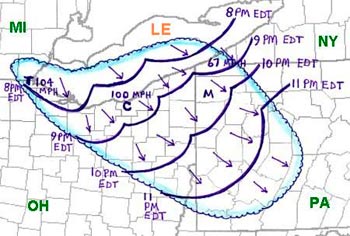
It was a Friday night, July 4, 1969, and while we always referred to it as the July Fourth Storm, years later I learned that the night was a documented weather event and even had a name: The Ohio Fireworks Derecho.
“Where were you during the Fourth of July storm?” wrote Tom Gearhart in the Sunday, July 6 issue of The Blade.
That question is likely to be asked countless times in the next few years, both by those who weathered the wind and rain that shook the city Friday night, and by persons returning to northwestern Ohio to see its awful aftermath.
The storm may have been the most violent in Toledo’s history, but few persons need to be told that fact…
 A derecho is a widespread and long lived windstorm that is associated with a band of rapidly moving showers or thunderstorms. Sometimes tornadoes are associated with them; sometimes not. Who knew? Not me, at age 6. But Toledo had both that night, and it was a night I still remember, and the evening is probably buried in the memory of many now-adults.
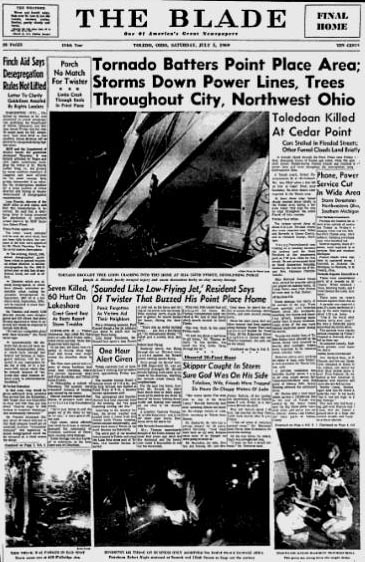
The next-morning coverage told how “at least three other funnel clouds touched down briefly in the Toledo Area during a tornado watch that kept the city on edge throughout the entire Fourth of July evening. …
“Storm damage was heavy in all sections of the city. Trees were uprooted, and branches blown about like toothpicks, smashing into homes and blocking streets, knocking down power lines in many locations. Large areas of the city were without electrical power during the storm. … ”
Heavy flooding affected a substation in an area which served the Sylvania-Bancroft-Secor area (quite a large area) and parts of Ottawa Hills. When it shorted out, the loud explosions and fire generated reports of a plane crash in the area. Edison also said a steel tower which carried a 138,000 volt line to the east of Toledo went down, cutting power to parts of Ottawa County.
Friday’s paper reported no local casualties, except for a Toledo man killed at Cedar Point in Sandusky when a tree fell on him.
In the Sunday paper, however, three other deaths were attributed to the storm: a man who jumped into Maumee Bay to escape a fire on his boat, and two people – one a 17-year-old Start High student and an Oregon man – who touched live wires. Monday’s paper reported that a fifth man, a Toledo Edison employee, was electrocuted Sunday. Eventually, 18 deaths were attributed to the storm that started in Michigan, plowed through Ohio and ended up in Pennsylvania.
Over 5,000 trees were knocked down. Over four inches of rain fell, a record at the time for any July day. A wall fell at the Continental Inn along the Detroit-Toledo Expressway near the Turnpike. A tree fell on the roof of the Kent branch of the public library (the same branch would burn down five years later during the snowstorm on December 1, 1974).
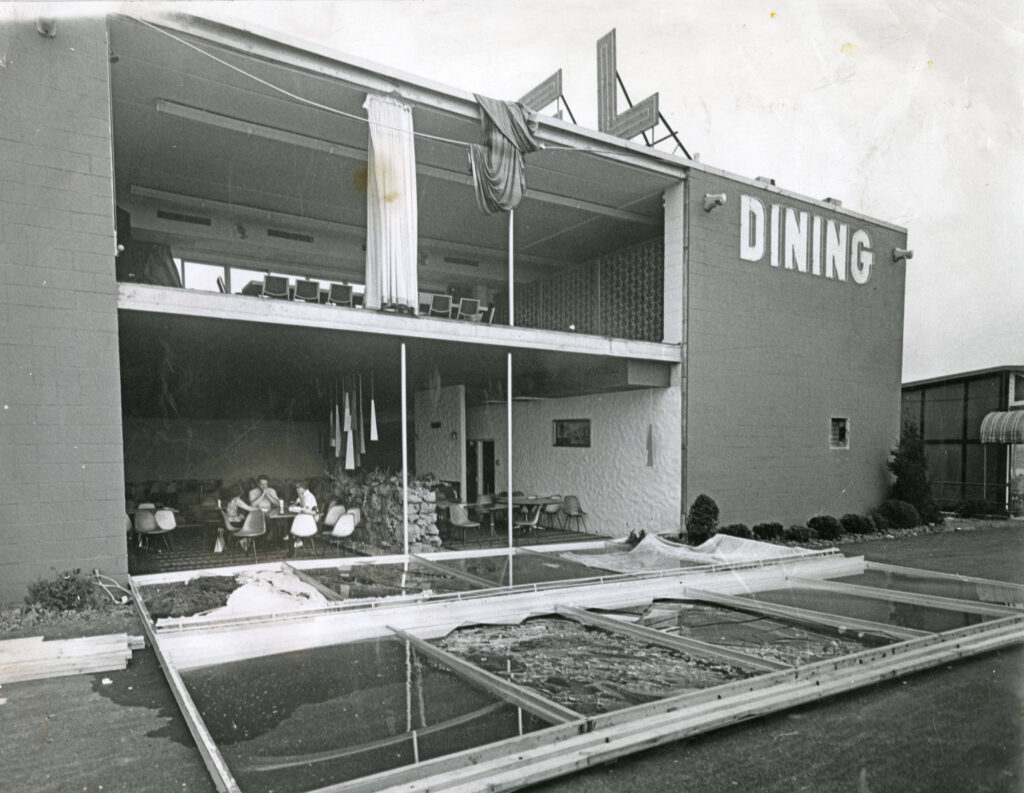
The widespread scope of the damage became apparent. Port Clinton was hit especially hard, and the storm went east to Cleveland and into Pennsylvania before dissipating.
Power was still out over a wide area. Underpasses along the Detroit-Toledo Expressway were small lakes. An 8-million gallon water and oil storage basin overflowed at the Sun Oil refinery in East Toledo, creating a lake of oily water in the Navarre/Coyne area around the Toledo Terminal Railroad overpasses.
One thing to emerge that night, however, was help from ordinary people.
Hundreds – perhaps thousands – of Toledoans braved Friday night’s storm to voluntarily take places beside police, firemen, utility trouble crews, and others trying to limit the chaos unleashed by the elements.
Seemingly coming out of nowhere, the citizen volunteers materialized in the dark and deluge that drenched the city, taking to the streets in every section of the town…they guided traffic, pushed stalled cars through high water, and opened their homes to persons temporarily stranded by the water. …
Numerous instances of volunteer assistance to stranded motorists in almost every section of the city were reported to The Blade Saturday.
Monday’s paper had an editorial commending police and firemen, the public sector generally – including Mayor Bill Ensign and his officials – as well as utility workers and private citizens. So, pretty much everybody. “It was, in all, an inspiring demonstration of a community meeting a crisis unselfishly and with a minimum of disorder.”
A week later, after the damage had been cleared and the estimates tallied up, the news moved on to another big event getting ready in Florida: the launch of Apollo 11.
A year later, a story that offered a historical perspective – $20 million in damage in Lucas County alone, a state death toll that exceeded 40 – began:
Remember the Fourth of July, 1969?
How could anybody forget?
Monday’s paper had an editorial commending police and firemen, the public sector generally – including Mayor Ensign and his officials – as well as utilitie workers and private citizens. So, pretty much everybody. <a href=”http://news.google.com/newspapers?id=P8owAAAAIBAJ&sjid=sQEEAAAAIBAJ&pg=7037%2C1922596″>”It was, in all, an inspiring demonstration of a community meeting a crisis unselfishly and with a minimum of disorder.”</a>
Some good reading:
The Ohio Fireworks Derecho page at NOAA’s Storm Prediction Center website
July 5, 1969
‘Sounded Like Low-Flying Jet,’ Resident Says Of Twister That Buzzed His Point Place Home
July 6, 1969
Sheer Violence of Storm Awesome, Terrors Won’t Soon Be Forgotten
Great article! I lived on the lakefront in Lorain, OH and will never forget that night. It is my understanding that there were no tornadoes confirmed by the Weather Bureau after that night anywhere in Ohio. Do you know if The Blade ever reported that? Perhaps my information is incorrect, but I’m quite sure it’s correct.
The man in the July 5 story was probably hearing the rush of wind out in front of the derecho.
Thanks, and Happy 4th to you!
I remember this. I was 9 years old at the time. There was also a series of storms in Toledo called the “Palm Sunday” tornadoes (1965) that leveled the shopping center at Sylvania and Berdan, I think it was called Devereaux Village. That’s where Betty Timko’s Soup and Such was located, but after the storms.
Great website!
I remember the Palm Sunday tornadoes well as my oldest daughter was only two weeks old, my son 2 1/2. What a scary time. We lived in a ranch house on a slab and had no where to go. We were living in South Toledo and were not directly hit.
Deveaux Village was at Sylvania and Douglas.
I was 13 at the time, I will never forget the sound of that tornado. I heard a loud horrible sound, the next morning I knew what the noise was, it was the neighbors roof being pulled off. The sound of the tornado gave me an uneasy feeling , not to mention , the feeling that my ears were being crushed by the high pitched sound of the crazy tornado. The vibration of the storm was incredable Yes it is something I will always remember all of my life
I wasnt born yet but have memories of it from family … DISTINCT MEMORIES becuse they where out on lake Erie in a boat that everyone but my grandfather returned from. My grandfathers body was never completely recovered either. He was was found only becuse of the I.D. in the back pocket of the lower half of his body. My grandmother was on the boat and didnt find out or know until a week after the tornado she was pregnant. My uncle never got to meet or see his father , and neither did any of his grandchildren.
I was living on the lakefront in Lorain at the time and remember my Dad calmly taking all 4 of us kids to the farthest room from the waterfront which was my cousins bedroom. He put a blanket on the floor in the corner and he said we had to wait there til the storm was over. We weren’t scared because he had a flashlight. But it never stopped. We were so tired of waiting for the storm to stop so we could go to bed. I was the oldest at 7. Finally he said the storm wasn’t going to stop so we went to bed. The next day we looked outside and there trees down everywhere. My mom came to pick us up to take us to our cottage in Vermilion and she drove down by Romps on the river and it was so flooded with boats destroyed everywhere. You couldn’t get to the other side of town.
I rember this fourth of july my husband and two sons five years and three years and our baby girl 9months old. We lived on ohio street in toledo Ohio I was sitting in my rocking my baby to sleep my husband was takinga nap with our boy’s all of a sudden i look out the window and a sign from a mall called Ontario’s came flying through the air and i saw a huge funnel cloud twrilling toward our aparment building i ran the bed room and woke my husband he took one look and trew the mattress over all of us it knocked every window out of that aparment building out and we were without power for a week we had planed to go to the fireworks but that had to be canceled i now live in my home town in tenn but i will never forget the tornadoes of july 4th 1969 we went to point place the next day it was a destroyed
On July 4, 1969 I was a 12-year old living in Bay View, Ohio on Sandusky Bay near the city of Sandusky. It had been a pretty typical July day and a bunch of us were playing baseball at the local park (Bay View had a population of 900 at the time) that late afternoon. One of my friends pointed out that sky was looking increasingly funny, many people reported a green cast prior to the storm, but I don’t recall the color. We played a while longer when we all noticed that the sky was literally black over the lake and that the temperature had dropped markedly in a short time. Living up there we had all experienced Noreasters and we agreed that this might be one and headed home pronto. My brother and I got on our bikes and started hightailing it the approximately 200 yards down a stone road that led to our house, which was one the bay front. The wind became so intense that I had to ditch my bike and crawl the last thirty yards. I looked back to find my brother who was still trying to ride his bike when the wind flipped over backwards, bike and all. I went to help him and he was shaken but none the worse for the wear. When we got into the house things got REAL. the front of our house was 40-50 feet from the shoreline and waves were literally crashing onto the roof and sometimes all the way over the house to the back yard. It was as though the house was underwater. We had no basement so we rode it out in the middle of the house. In 10 minutes it was over, but the flooding covered every square inch of what had normally been high and dry land. We put on boots and ventured outside to discover the sight of our slice of Sandusky Bay having NO water for 150-200 feet out into the bay. The water depth off of our small dock was normally six feet and there was no water extending the aforementioned distance. We walked out into what was normally the bed of the bay finding stranded fish flopping helplessly, ice fishing shanties that had fallen through the ice at some unknown date, and a host of other things normally otherwise unseen due to being covered by the bay. I am now sixty and have experienced a violent derecho in 2012 in Allen County, Ohio along with a couple of tornados that didn’t get especially close to our home, but nothing is burned into my memory as being near as violent as that savage storm. The village built a four-foot dyke along the entirety of the village’s bay front in response which has since been removed.
I was a 5 year old kid at that time. We lived on Lodge st in the south end. I remember the event like it was yesterday. It was in the late afternoon when we first heard the tornado sirens and I remember hiding in our basement and seeing the white picket fence that was in between our house and the neighbors go flying straight up into the air. The next day I rememher being told that a tornado had touched down by Glendale and the Trail and traveled down the trail to around Otis Elevator by the train crossing by the zoo. I never saw any evidence to back that up. But I remember the noise that it made and the only thing I can compare it to is when we have a hurricane where I now live in Boca Raton Florida
I was a kid then. We did fireworks at the club (Inverness). They had Quacky the Clown entertaining the kids. On the way home (Corey Woods) our station wagon got stuck in Ottawa Hills. I was deathly scared of thunderstorms. That was one scary July 4th storm from a kid’s point of view.