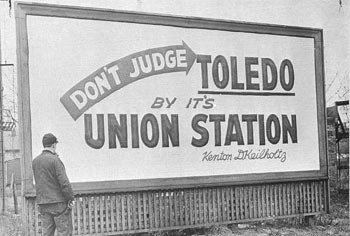

Back in the days before air travel, the most traveling people saw of a city sometimes was its train station. Some cities had memorable train stations (Kansas City, Cincinnati), true gateways to their communities. But prior to 1950 Toledo’s rail visitors were greeted with a dump. The city, by all accounts, considered the 1886 building an embarrassment.
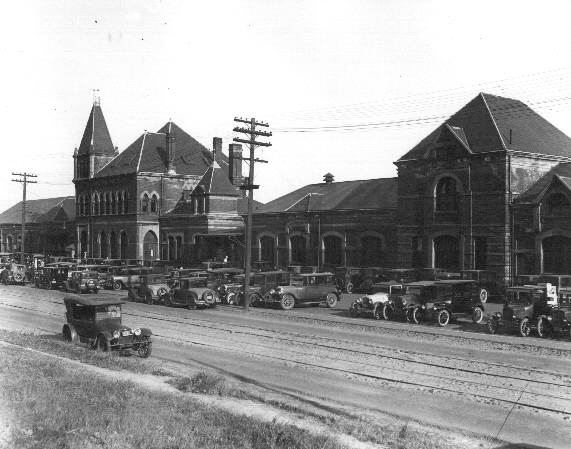
What was wrong with it? Well, sixty years after the fact, one can only guess, because while papers of the era point out that it’s an eyesore, they don’t go into specifics. Bad restrooms? Lousy restaurants? Rodents? Holes in the roof? Nobody ever really said. But the replacement of Union Station was one of the News-Bee’s big priorities (it didn’t live to see it happen unfortunately). Life Magazine, in describing the Toledo Tomorrow exhibit in 1945, called Union Station “old, grimy and thoroughly inadequate.” When the new Central Union Terminal opened in 1950, The Blade didn’t hold back:
To strangers in town during Union Station Dedication Week, it may seem odd that a city as large as this should make such a great to-do over a new depot. Even when they contrast the remnants of that old eyesore with the most up-to-date railroad station in America, they may still wonder why that calls for dancing in the streets and all the hullabaloo of a three-ring circus.
But that ancient and dreary Union Station was more than a threadbare joke in this community. In a truly psychic way it had become a fixation in the minds of our people. They might urge others not to judge Toledo by the appearance of its Union Station; they could not help doing that very thing unconsciously themselves. As long as that old, ramshackle building stood there, people were bound to think of Toledo as sort of run-down, shabby city.
The inferiority complex which the antiquated station gave this city manifested itself insidiously in various forms. It created the impression that the citizens of Toledo must be awfully stodgy people and generally set in their ways. It contributed to the feeling that Toledo lacked the initiative and the vision to put big civic projects over like other cities.
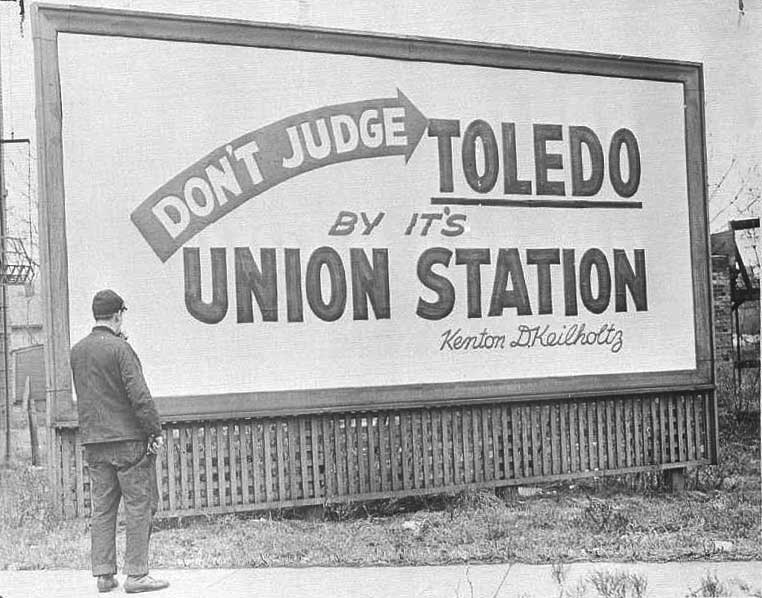
The editorial is referring to a billboard (at left) erected by Kenton Drake Keilholtz, then president of the E.L. Southworth Co., a grain and seed company, which went up in 1943.
The sad state of affairs necessitating this sign was an amazing thirteen years after the events of June 10, 1930, when the old station caught on fire.
The fire, which caused $100,000 in damage, was big news, and according to accounts, thousands gathered to cheer the depot’s burning. The News-Bee put it this way: “In all parts of the huge throng of more than 5000 spectators who watched the firemen from behind police lines could be heard the universal thought of Toledoans expressed aloud – ‘The best thing that could have happened to the city, now we’ll have that new depot.’ ” The News-Bee seized on the chance to urge the New York Central to build a new depot, front-page style.
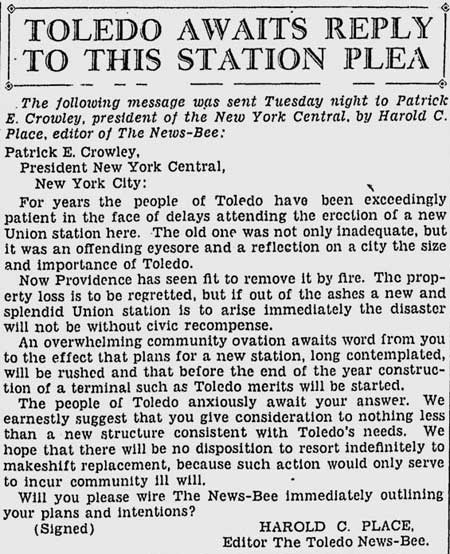
And judging by the photo on the front page of the News-Bee, how could the New York Central not build a new station, right? Right?
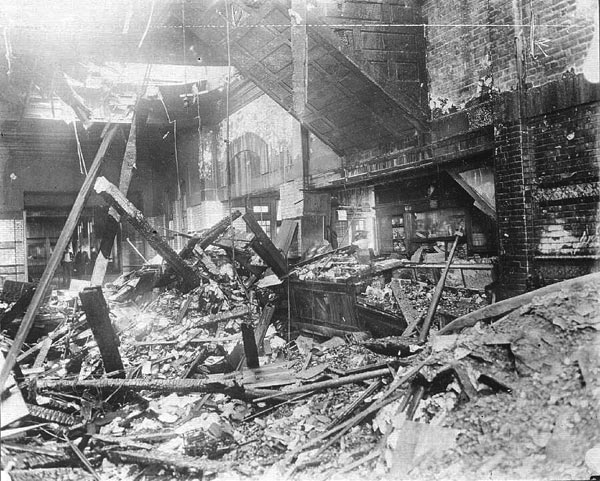
Wrong. The railroad quickly poured cold water on that suggestion: “Our chief concern,” according to R.D. Starbuck, vice-president of the railroad, “is to repair this present station. We shall do this at once.”
Undaunted, two days later, citing an “authentic” source, the News-Bee excitedly revealed plans for a new, $2 million Union Station: three stories of white stone facing Broadway. The plans were virtually complete, the story said, and all that was needed was the New York Central to appropriate the money.
It didn’t happen, and nothing materialized for quite a while. The Depression and World War II no doubt played a part in the inaction. It took until October, 1945 – the day before the Blade-sponsored Toledo Tomorrow exhibit was to end – for the NYC to get going on a new station. The New York Central allocated $3.5 million for the building of the new Union Station, to be built as soon as manpower and material conditions permitted. Plans showed up on the City manager’s desk two days later.
The new Central Union Terminal, known as Dr. Martin Luther King, Jr. Plaza since 2001, opened in September, 1950. A writeup of the hullabaloo (a week-long celebration) that was the new terminal’s opening is here.
It’s really too bad that they dont teach a History of Toledo class in grade school there in T Town.I am origionallyvfrom Toledo but I live in Boca Raton Fl since 1991 because I had just been layed off from my job and a friend of mine asked if I wanted to go to Ft. HIM. I came back from Fl when my brother died in 2005 for a couple of years and I occasionally went to the Downtown Library an while I was there I got into checking out the history of Toledo and it is pretty interesting and I had thought that it would be cool to teach grade school kids the history of Toledo with pictures and field trips. For instance how many people know that the Anthony Wayne Trail used to be a two channeled canal and how Swan Creek was moved 300 ft north where it crosses Sumit st. That is why they have never been able to make Sumit st flat level and smooth there just north of Friches Big Boy if that is still there. Any way that is just an Idea I hadn
The other thing to remember is that at the time, the idea of historical preservation of 19th-century structures was a foreign idea. And old buildings didn’t line influential pockets in the same way as the construction of new ones. This little drama was played out all over the country, with lavishly-constructed rail palaces wiped out.
So, from another perspective, Toledo got an expensive concrete-blockhouse just in time to witness the collapse of passenger service.
central union terminal, when it was revived as a passenger train station in 1975, was only 25 years old.
and it was in this era that i began using the depot regularly — first, as a student at the university
of michigan whose home town was new york city and second, beginning in 1977, as a resident of toledo.
the building was cleaned up when amtrak began running the lake shore limited — it was painted and the
“built-in” appliances were placed in good repair. for example, the 1950 otis elevators — the building had
two — were working and ready to take folks down to track level. an ample supply of brand new luggage
carts appeared, and were very useful with the ramps which led to the platforms. what was striking
at the time was the structure existed “as built”. while the barber shop, restaurant and news-stand
were all closed, their footprints remained. it was possible to see exactly what the design of the depot was on the day
it opened. the structure was also full of people. local operations for both penn central and its successor
conrail were headquartered there — so in addition to passengers, a number of other people worked there
and gave it a populated, “lived-in” feeling even though only two trains a day stopped there.
we also had excellent amtrak agents. they mastered the balky new amtrak reservations computer and
were friendly and able. they kept the place clean, made sure those luggage carts were distributed out
at the entrance and down by the tracks every day. and – wonder of wonders – even though the
passenger areas of the depot were not air conditioned, they rigged up the windows and fans mounted on
the ceilings so that, even on a summer day, it was cool and pleasant inside. as for winter, the steam heat
worked perfectly — no one was ever cold at central union terminal in the late 1970’s. for a span of about
five years, my “home” station was toledo — i almost never flew to my “other” home, new york city during that period — and i found it to be a fine home, indeed.
Nice comment above from Guy
Guy, you captured that era at CUT perfectly. I loved the “glass capital of the world” mural. All the Vitrolite and glass blocks was the epitome of mid-20th century America. Even the wood phone booths with windowed doors that closed for privacy, a place to sit, and a fan that worked – it was all there. I also bought a number of tickets there and enjoyed some meals at the lunch counter. What a place it was. Wish I’d been there to see it in the early 50s when it was full of activity.
i think we were lucky to have had access to and use central union terminal in
the 1970’s. although it was “much too big” for two trains a day, i always felt welcome there
and i also felt amtrak did very well with maintenance, chairs, luggage carts and
personnel. also, i loved the “museum quality” of the place, even though it wasn’t
technically a museum. the pa system was the same tube-powered apparatus installed
in 1950; the ticket windows had little flip-up metal signs which said ‘closed’; the
recessed incandescent and florescent lighting within the structure – and all the exterior fixtures –
were as they had been during the fifties. pleasantly, as i have mentioned b4, the public
areas were all painted in 1975 – the bridge out to emerald avenue, the main waiting area
and even the platforms got a fresh coat of what appeared to be original color, along
with simple but clear new signage. the ramp down to the track (NOT repainted, as i recall) worked just as well in 1976 as it did in 1951 – and, account the signage, arriving
passengers knew they could use that ramp, the stairs or those trusty automatic otis
elevators to access the station proper. going back to the pa, i was fascinated that it sounded “different” depending on where one was: out by the entranceway and on the platforms, it had a dry, crisp quality; in the emerald street passageway, it became a huge
echo chamber and in the waiting room (account the loudspeakers?) it sounded like the
audio in a movie theatre. within this vintage environment, at several of those lovely
ticket windows, sat the wonders of the age: new computerized ticket machines used
by the agents. they mastered those clunky contraptions and one could call ahead, make
a reservation (with a human being in the station!) and pick the ticket up at lunch or after work. as monte mentioned, the lunch counter came back – and one could find oneself
having a hamburger next to a friendly penn central or later, conrail, despatcher. i am glad
the building has been “saved” and rehabilitated, but i will always have fond memories of
all the journeys i began or ended in cut from 1975 to 1981.